
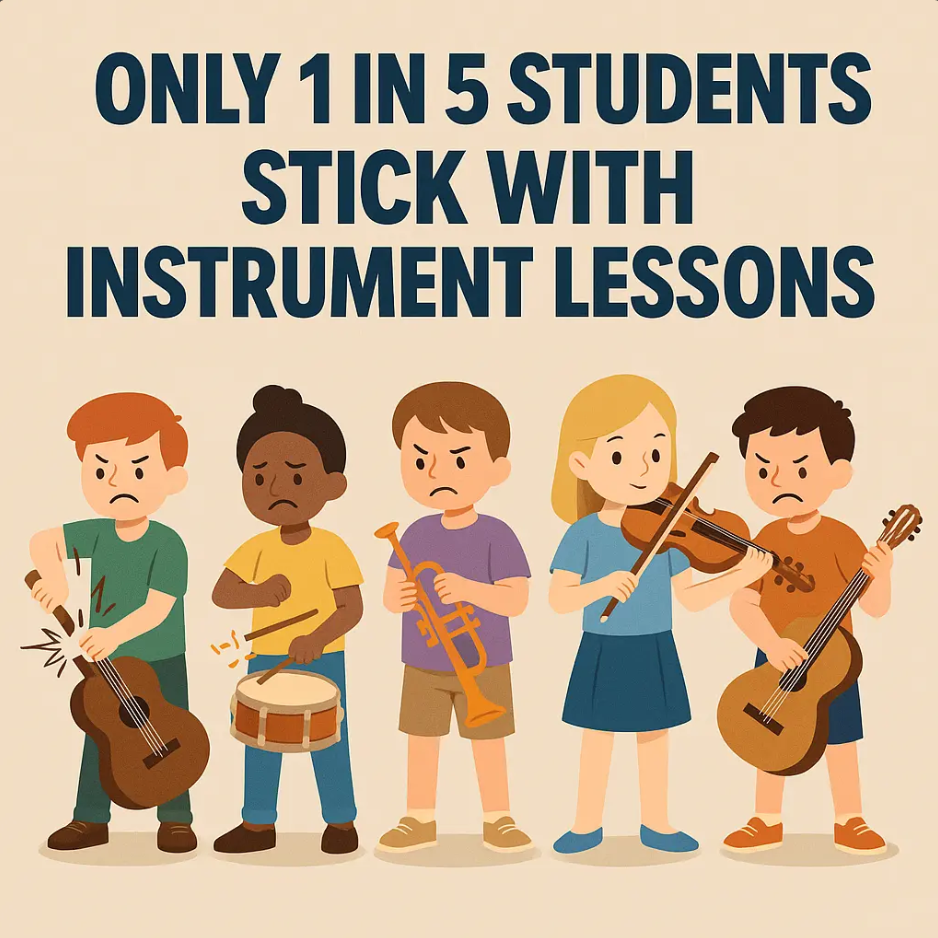
Dropout rates for music lessons at an all time high.
By the age of 17 studies show 50% of students throw in the towel on music lessons. Even though 92% of kids are capable of learning music, after 3 years of lessons only 1 in 5 students will continue on the path of music. The problem isn't talent. It's time.
I've been tracking retention data in music education, and the numbers tell a story traditional teaching methods don't want to hear. Somewhere between the first scale and the third recital, 80% of students walk away from their instruments. The usual explanations point to motivation, discipline, or parental involvement. But the research reveals something more fundamental.
The Math Is Brutal
Learning violin requires roughly 2,000 hours of practice to reach moderate competence. That's an hour a day for five years. Compare that to a video game. Two hours gets you to level three, with visible progress, immediate feedback, and a sense of accomplishment. If you're a teenager choosing how to spend your time, the choice is obvious.
The Attention Economy Changed the Rules
Gen Z operates with an attention span under 8 seconds. They've grown up in an era where instant gratification isn't a luxury, it's the baseline expectation. Music education still operates on a 19th-century timeline. Master your scales. Perfect your posture. Wait years before you play anything that sounds like actual music.
The gap between these two realities creates friction that most students can't tolerate.
Where the System Breaks Down
Traditional teaching relies on verbal instruction and delayed feedback. A teacher describes what you did wrong after you've already done it. You try to remember the correction for next week's lesson.
This creates a cycle where students misunderstand or forget technique details, leading to frustration and slower development. Eventually, they quit. The master-apprentice model worked when students had different expectations about learning timelines. It doesn't work when every other skill they acquire shows immediate, measurable progress.
What Modern Music Learning Looks Like
DJ lessons tell a different story. Students can create a recognizable mix in their first session. They're working with music they actually listen to, using tools that feel intuitive, and seeing results in real time.
The learning curve rewards experimentation. Drop a beat, blend two tracks, add an effect. The feedback is instant and the progress is audible.
More importantly, the skills translate immediately to social currency. A beginner DJ can play at a party within weeks. A beginner violinist needs years before anyone wants to hear them perform. The appeal isn't just about speed. It's about relevance. DJing connects to the music culture kids are already immersed in. Traditional lessons often feel disconnected from the music that matters to them.
Electronic dance music has become the cultural soundtrack for this generation. John Summit went from bedroom producer to headlining festivals in just a few years. Martin Garrix was 17 when he produced "Animals" and became a global phenomenon.
These aren't distant legends from another era. They're young artists who built their careers using accessible technology and modern production tools. The pathway feels achievable. When a kid watches a DJ perform at a festival, they see someone manipulating the same software they could download tonight. The barrier to entry is low. The ceiling is stratospheric. EDM culture celebrates the producer-performer hybrid. You create, you perform, you connect with an audience. The entire cycle happens faster and feels more aligned with how this generation consumes and creates content.
What This Means
Music education faces a retention crisis because it's optimized for a world that no longer exists. The pedagogical approach hasn't caught up to how modern students learn, process information, or measure their own progress.
The 80% dropout rate isn't a student problem. It's a system design problem. The solution requires more than minor adjustments. Music education needs to reconcile centuries-old teaching methods with the reality of how modern students learn and what motivates them to stay engaged. Without that fundamental shift, the 80% dropout rate will remain the norm, and traditional music programs will continue losing students to alternatives that better match their expectations and culture.
by Jash Negandhi
Oct 14th, 2025